Search Intent: The Story Behind the Click

Every click has a backstory.

It began with a person feeling friction. Confusion. Desire. Fear. Curiosity. A problem that hadn’t resolved itself quietly enough to be ignored.

Search intent is simply the story that moment tells.

And if you want to run successful marketing campaigns, your first job is understanding the character behind the click.

Every Campaign Starts with a Character

In fiction, a story doesn’t begin until we understand who the character is and what they want. Marketing is no different.
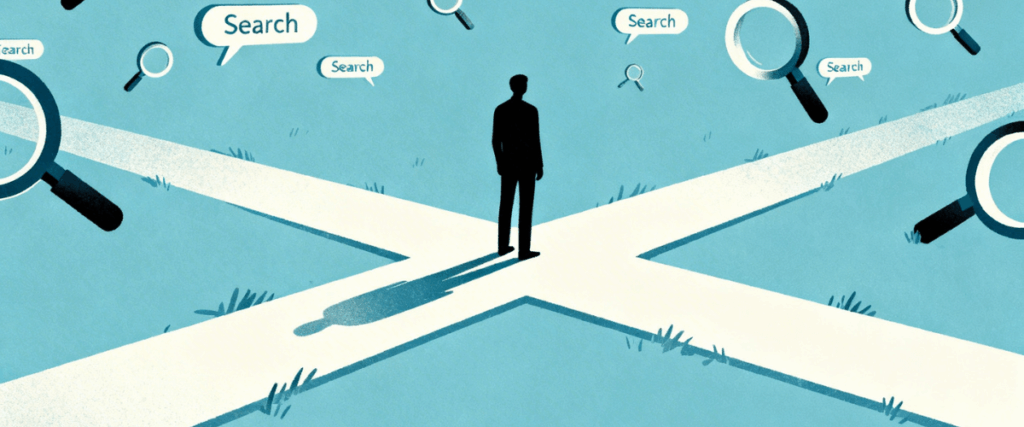
Before a campaign launches, before keywords are selected, before budgets are assigned, a marketer has to answer a deceptively simple question:

Who is this for?

If you answer that question with basic demographic info and surface-level assumptions, your campaign will show it. Likewise, if you put some work into it and answer it in a way that reflects how real people think, hesitate, and decide.

This is where persona building matters. When done well, a persona isn’t a profile. It’s a point of view. It captures what someone fears wasting time on, what they’re hoping to avoid, what they’re willing to pay for, and what feels out of reach.

Without this depth, marketing is guesswork. With it, marketing becomes informed speculation, something far more powerful.

From Guess to Hypothesis

There is a world of difference between a gut instinct and a hypothesis.

A guess sounds like this:
“People searching for this keyword probably want what we’re selling.”

A hypothesis sounds like this:
“Based on what we know about this person’s motivations, urgency, and constraints we believe this search reflects readiness for this solution.”

That difference matters.

Search intent isn’t something you know when a campaign launches. It’s something you infer from the story you’ve learned about your audience. Persona work turns vague assumptions into reasoned beliefs. It gives your marketing a spine.

The Click Is a Plot Point, Not the Story

A click feels like victorious progress. When it represents the instant where desire edges out doubt or where the problem feels just painful enough to explore a solution, it is.

However, a person searching for “free course on Power BI” and a person searching for “best Power BI training program” may look similar in a keyword report, but they are in entirely different chapters of their story. One is avoiding cost. The other is evaluating commitment.

When campaigns fail, it’s usually not because the creative was weak or the bids were wrong. It’s because the story you told yourself about the searcher didn’t match the story they were living.

Data as the Editor, Not the Author

Data doesn’t write the story. It edits it.

It tells you whether the narrative you constructed about your audience holds up under scrutiny. It reveals where your understanding was accurate and where it drifted into fantasy.

When personas are shallow, data is little more than noise. When personas are deep, data becomes clarification.

Understanding search intent in marketing isn’t about prediction. It’s about preparation. About doing the hard, human work upfront so that when the numbers arrive, they’re answering a question worth asking.

Conclusion

Every great story begins with a character who wants something and feels enough discomfort to act.

Every effective marketing campaign does the same.

Search intent is the bridge between those two worlds. It’s the story behind the click, the moment when pain, desire, and possibility intersect.

Better performance doesn’t start with the dashboard. It starts with the person. Build them carefully. Know them deeply. Let your campaigns rise from that understanding, and you’ll get your story right.


SEO in the Age of AI: Why Understanding Searcher Pain Still Wins

From PageRank to AI-generated answers, SEO has evolved—but its foundation hasn’t.

Long before AI began summarizing answers and search engines started predicting intent, SEO was already changing. Google’s early PageRank algorithm rewarded backlinks. Later algorithms rewarded keywords, then relevance, then authority, and experience. Each evolution sparked the same reaction: Everything has changed.

And yet, beneath every technical shift, the reason people search has remained remarkably consistent. It’s all about pain.

Informational Searches: “I Don’t Understand”

When someone searches “how to bake bread” or “history of Rome,” it looks harmless, even academic. But at its core, an informational search is driven by cognitive discomfort, the gap between what someone knows and what they feel they should know. (A slight pain.)

Navigational Searches: “I Need to Get There”

Searching “Amazon” or “YouTube login” means the user knows where they want to go but feels blocked by inconvenience, memory, or some other issue. (Irritation is pain.)

Transactional Searches: “I Need This to Change”

Queries like “buy new iPhone” or “cheap flights to Denver” are driven by urgency, desire, and more often than not some level of anxiety. The user wants resolution and reassurance that they’re making the right decision. (Transactional searches represent strong pain.)

Commercial Investigation Searches: “Help Me Choose”

Searches such as “best laptops 2026” or “compare car insurance” reveal fear of regret. The user is close to action but something doesn’t feel right. They’re looking for clarity, confidence before moving forward. (Discomfort equals pain.)

Local Searches: “I Need Help”

Local searches often happen under pressure. Hunger. Physical discomfort. Time constraints. Searching “dentist near me” or “emergency plumber” isn’t theoretical. The pain here is real, and relief needs to be close.

Voice Searches: “Answer Me Without Effort”

Voice searches like “Hey Google, what’s the weather?” reflect cognitive fatigue. The pain isn’t the problem itself—it’s the effort required to solve it. Voice search exists to reduce friction when attention and energy are already depleted.

AI / LLM Searches: “Help Me Think”

AI-driven searches such as “plan a 3-day trip to Paris” are born from overwhelm. The user isn’t just looking for facts—they’re looking for synthesis, judgment, and reassurance. The pain here is complexity itself.

AI is a powerful tool. It can accelerate research, surface patterns, and generate drafts. In many ways, it’s a glorious addition to the marketer’s toolkit.

But AI does not feel pain.
It can reflect it, but it cannot originate it.

What Hasn’t Changed And Never Will

Algorithms will continue to evolve. Platforms will rise and fall. Search interfaces will become more conversational, more predictive, more automated.

But SEO will still belong to those who understand the pain, no matter how slight, behind the search.

Even entertainment searches are often driven by boredom, stress, loneliness, or the need to escape. Search queries are simply inciting incidents written in lowercase.

The most effective SEO strategies have never been about pleasing the algorithms. They’ve been about understanding people and their hurts and what resolution may look like from their point of view.

That’s why SEO in the age of AI doesn’t require less humanity. It requires more.

Marketing Leadership | Key Superpowers of Great Marketing Leaders

Superpower #1: Strategy (Seeing the Future and Aligning the Path to Reach It)

The first job of a marketing leader is that of strategist. In our previous article, we touched on the painful truth at the heart of strategy:

“Strategy is clarity forged through friction. The marketing leader must ensure that every campaign, post, and piece of content aligns with an ever-larger business strategy. This is painful work, the kind that demands discipline when chaos feels easier. But it’s also where leadership proves its worth. When everyone else is staring at pixels, the leader sees the picture.”

This article builds on that concept because the first and most important superpower of great marketing leadership is strategic vision. Without it, nothing else works.

1. The Pain of Vision: Seeing the Picture When Everyone Else Sees Pixels

A strategist sees the future long before it’s comfortable to believe in it.
While others are focused on next quarter’s numbers, the marketing leader thinks in long arcs:

  • Where is the industry headed?
  • What will our customers need a year from now?
  • How should we position the brand today to win tomorrow?
  • What story are we building, and does every tactic reinforce it?

This kind of foresight is painful. When you can see the picture and others can’t, you become the one responsible for holding it steady. This is true even when the present is chaotic, uncertain, and full of resistance.

Great marketing leaders endure that discomfort. They don’t collapse under doubt.
They don’t abandon the vision because others can’t yet see it. They become the keeper of what the company could be. That’s the weight and the privilege of strategic marketing leadership.


2. The Discipline of Alignment: Turning Vision Into a Plan the Entire Company Can Follow   

Strategy means alignment, the unglamorous, relentless, often painful discipline of ensuring every piece of marketing ladders up to the business objectives.

That means:

  • Saying no to ideas that are awesome, but not aligned.
  • Killing campaigns that are clever, but not strategic.
  • Refusing to chase appealing trends because they’re not the right long-term fit
  • Ensuring product, sales, and ops see marketing not as a service but as a strategic engine of growth.

Alignment means stepping into conflict. It means being misunderstood. It means disappointing people. It means taking a stand not because you want control, but because your responsibility is the company’s direction, not its comfort.

In the end, alignment becomes its own form of quiet leadership. When others are pulled in twenty directions, the marketing leader is the one who says:

“This is the path. This is why it matters. And this is how we walk it.”

3. Future-Focused Leadership: the Courage to Keep Evolving

Finally, marketing leadership is the ability to treat strategy not as a static document, but as a living map that adapts to the shifting terrain of:

  • Markets
  • Consumer/buyer behavior
  • Economic realities
  • Technology
  • Culture
  • Company priorities

Great marketing leaders go beyond planning campaigns to planning systems. They build marketing-engines with strong capabilities that can scale fast. Even more importantly, it can evolve because the moment the market shifts it will have to.

Future-focused leaders don’t fear market change. They anticipate it. They don’t cling to the past. They turn it into fuel for a better future. They don’t hope the future will be kind. They shape it.