Every click has a backstory.
It began with a person feeling friction. Confusion. Desire. Fear. Curiosity. A problem that hadn’t resolved itself quietly enough to be ignored.
Search intent is simply the story that moment tells.
And if you want to run successful marketing campaigns, your first job is understanding the character behind the click.
Every Campaign Starts with a Character
In fiction, a story doesn’t begin until we understand who the character is and what they want. Marketing is no different.
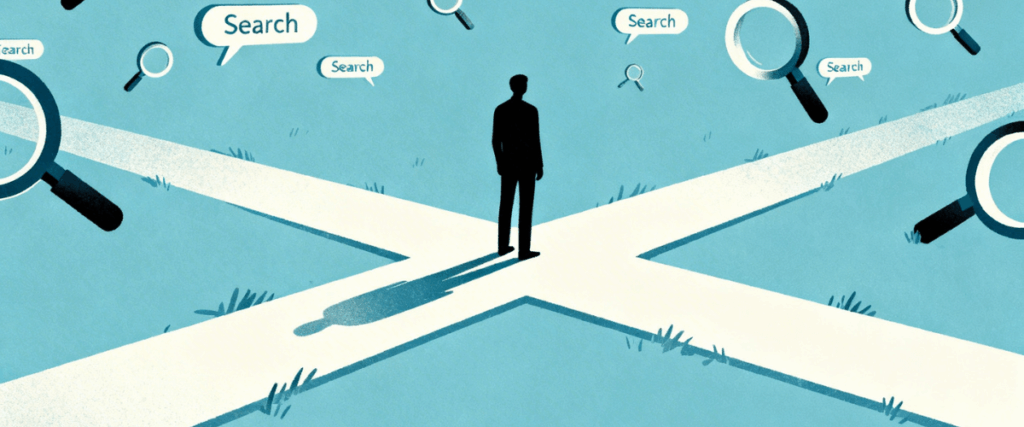
Before a campaign launches, before keywords are selected, before budgets are assigned, a marketer has to answer a deceptively simple question:
Who is this for?
If you answer that question with basic demographic info and surface-level assumptions, your campaign will show it. Likewise, if you put some work into it and answer it in a way that reflects how real people think, hesitate, and decide.
This is where persona building matters. When done well, a persona isn’t a profile. It’s a point of view. It captures what someone fears wasting time on, what they’re hoping to avoid, what they’re willing to pay for, and what feels out of reach.
Without this depth, marketing is guesswork. With it, marketing becomes informed speculation, something far more powerful.
From Guess to Hypothesis
There is a world of difference between a gut instinct and a hypothesis.
A guess sounds like this:
“People searching for this keyword probably want what we’re selling.”
A hypothesis sounds like this:
“Based on what we know about this person’s motivations, urgency, and constraints we believe this search reflects readiness for this solution.”
That difference matters.
Search intent isn’t something you know when a campaign launches. It’s something you infer from the story you’ve learned about your audience. Persona work turns vague assumptions into reasoned beliefs. It gives your marketing a spine.
The Click Is a Plot Point, Not the Story
A click feels like victorious progress. When it represents the instant where desire edges out doubt or where the problem feels just painful enough to explore a solution, it is.
However, a person searching for “free course on Power BI” and a person searching for “best Power BI training program” may look similar in a keyword report, but they are in entirely different chapters of their story. One is avoiding cost. The other is evaluating commitment.
When campaigns fail, it’s usually not because the creative was weak or the bids were wrong. It’s because the story you told yourself about the searcher didn’t match the story they were living.
Data as the Editor, Not the Author
Data doesn’t write the story. It edits it.
It tells you whether the narrative you constructed about your audience holds up under scrutiny. It reveals where your understanding was accurate and where it drifted into fantasy.
When personas are shallow, data is little more than noise. When personas are deep, data becomes clarification.
Understanding search intent in marketing isn’t about prediction. It’s about preparation. About doing the hard, human work upfront so that when the numbers arrive, they’re answering a question worth asking.
Conclusion
Every great story begins with a character who wants something and feels enough discomfort to act.
Every effective marketing campaign does the same.
Search intent is the bridge between those two worlds. It’s the story behind the click, the moment when pain, desire, and possibility intersect.
Better performance doesn’t start with the dashboard. It starts with the person. Build them carefully. Know them deeply. Let your campaigns rise from that understanding, and you’ll get your story right.

