Adam Cesare’s Clown in a Cornfield has been hailed as a slasher novel for young adults. But it’s far more than that because the story is rooted in mourning.
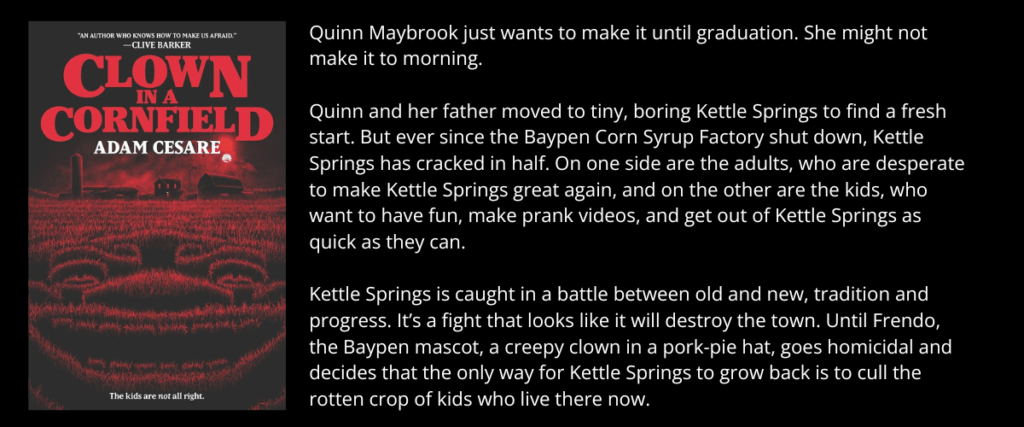
Its young characters are in mourning. Quinn, our new-to-town protagonist, is grieving her mother, along with the home and life she left behind. Colt, another pivotal character, is still reeling from the death of his sister. Rustin, a heroic ally character, is grieving, too, although he hides his sorrow so that it isn’t fully revealed until the story’s resolution. Their pain shapes them, isolates them, and ultimately draws them into the bloody conflict that descends on the town of Kettle Springs.
The adults in Kettle Springs are grieving too. Their once-thriving town has crumbled. The corn syrup factory that anchored the economy is gone. Traditions feel hollow, values feel disregarded, and in their eyes, the younger generation is to blame. They look at teenagers glued to phones, recording reckless stunts for their stupid YouTube channel, laughing at the world they’re trying to hold together and they see nothing but disrespect.
As I’ve said before, good stories and good marketing always begin in pain. In Clown in a Cornfield, Cesare brilliantly ensures that generational pain collides. The grief of the young and the grief of the old meet and ignite a bloody massacre.
This is why the book resonates so strongly. It isn’t just about a masked killer clown. It’s about what happens when two generations, equally wounded, cannot bridge the divide between them.
For younger readers especially, that conflict cuts close. Many teens and twenty-somethings feel they’ve inherited a broken system: climate crisis, student debt, jobs that barely cover rent. They see adults telling them to “work harder,” while opportunities vanish before they can grab them. That tension fuels the appeal of the novel. It’s cathartic to watch a story where the friction between generations finally erupts.
And what does that say about us, as a society? Maybe that we’re not as different from Kettle Springs as we’d like to believe. Our inability to bridge generational divides leaves both sides trapped in grief, anger, and suspicion. The younger feel misunderstood. The older feel discarded. And instead of healing, we circle one another with blame. Horror resonates here because it shows us the cost of refusing to find common ground.
It’s no wonder Clown in a Cornfield was a breakout success. It won the Bram Stoker Award for Best YA Horror Novel and kicked off a trilogy (Clown in a Cornfield II: Frendo Lives and Clown in a Cornfield III: The Church of Frendo). In 2025, the book leapt to the big screen under director Eli Craig (Tucker & Dale vs Evil). The movie grossed more than $7 million worldwide before moving to streaming platforms, proving that Frendo’s mask has power beyond the page.
Clown in a Cornfield may look like a simple slasher story, but its true terror is a mirror: one generation mourning the past, another mourning the future, neither willing to meet in the middle. That signals dark times ahead, doesn’t it?
Learn more about Clown in a Cornfield on GoodReads here.

